Patient Parenting 101

Easy behavior modification techniques to change the way you parent.

Easy Mindfulness Techniques Part 2: Visual

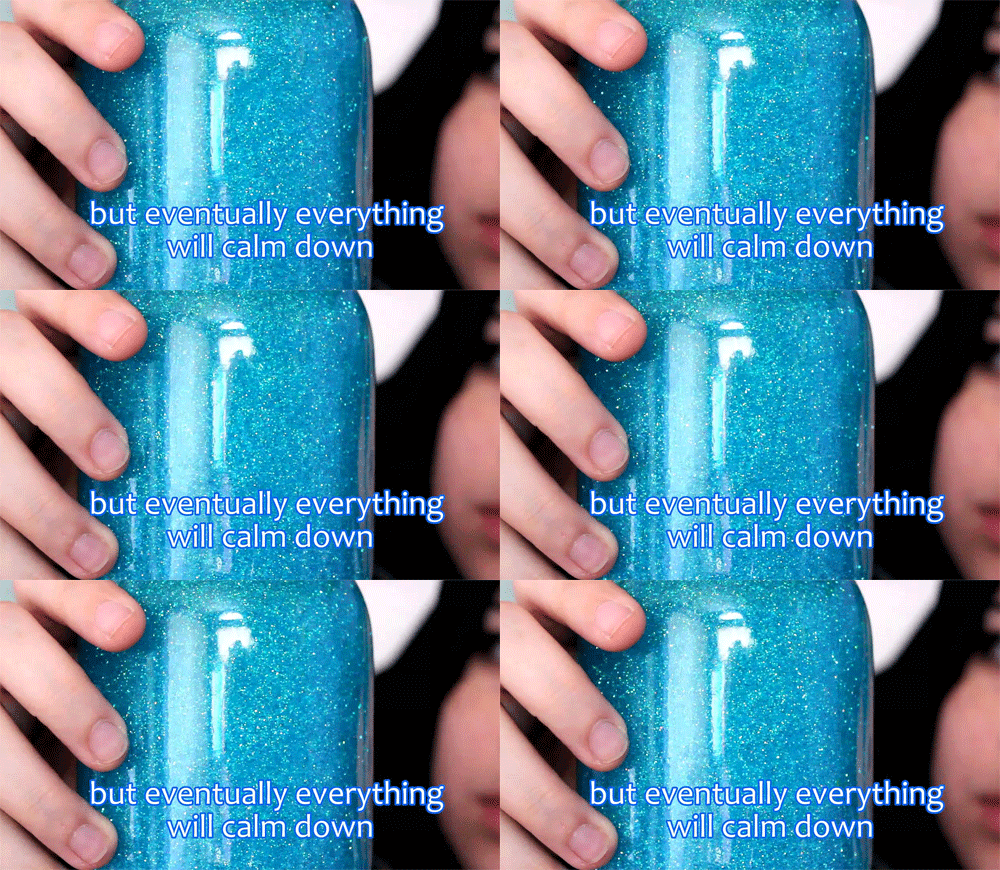
glitter jarWeek 2: Calming Glitter Jar

Everyone can benefit from a calming glitter jar. Shaking, turning and watching the glitter settle actually allows your body to receive important sensory input (visual and tactile) needed to organize thoughts, refocus attention and “rewire” your nervous system. Aside from all of the scientific reasons why it works to calm the brain, it is tons of fun, beautiful, inexpensive and easily accessible.

This jar can be taken out when a child is upset, frustrated or angry. This technique of redirection avoids all punishments. Instead it distracts and redirects the brain in a calming manner. Once the glitter has settled you can have a brief conversation about the emotions that were present. Many times a child gets frustrated and angry when they are not able to communicate effectively. It is our job to teach them effective and appropriate ways to do so.

Ingredients: (items can easily be purchased at a Dollar Store)

1) Plastic Bottle

2) 2 Tablespoons of glitter glue (your child’s favorite color)

3) an inch of extra glitter

4) 1 cup hot water

5) small figurine or toy (lego figure, doll)

Instructions:

Add items to clean plastic bottle in order. Leave an inch of space at the top for shaking room. Glue lid on bottle. Shake!

*The glitter can take anywhere from 1-5 minutes to settle. As it settles you will notice that your child can become “entranced” in the magic like qualities of the bottle – that is the brain relaxing 🙂

Enjoy!

Leave a comment »

Easy Mindfulness Techniques Part 1:

MINDFULNESS.

Our brain is the most complex thing about us.

We each need to take time to learn how to be the captain of this ship.

Week 1: Breathing

“One deep breath can change our world.”
-Oprah (or one of Oprah’s writers).

Regardless of where the sentiment comes from it is a very powerful statement indeed. If we think about our child’s brain development, we see that there is a gap in the education of their overall well- being.

Teaching mindfulness to our children from an early age will give them the tools that they need to develop emotional maturity, understand how their brain and body work and develop a deeply connected sense of self, safety and happiness.

Each week we will focus on one easy technique to teach our children (and perhaps ourselves) to bring our families into a state of mindfulness and wisdom about ourselves.

I have talked about breathing techniques before. I talk about them a lot because they are important, infinitely handy and free! You have to focus to do a deep breathing exercise, this is being mindful. Every person can deep breathe to change the chemistry of their body and brain at any given moment. Even one deep breath taken in a stressful situation has been scientifically proven to lower heart rate and blood pressure.

BUBBLE BLOWING BREATH:

1) Have child breathe in through their nose for 3-4 seconds
2) Release breath through mouth slowly
3) Wait 2 seconds
4) Repeat

bubbles

*Practice this technique with your children by actually blowing bubbles with them. The same breath is used, hence the name. You can even tell them to “blow bubbles” as a reminder to use their new breathing technique in a stressful situation.

Leave a comment »

Good news about whining!

Whining is a learned behavior. Yes, that IS the good news. It means that whining can be UNLEARNED 🙂

It is difficult to be patient when our children are whining. All children will test out this method and usually when we are on our last nerve. It is our job as parents to teach them a better, more appropriate way. We have all given in to the demands of a whining 3 year old  when we were tired, overwhelmed or distracted. If we give in our child will stop whining in that moment, but also learn that this technique works as a means to an end. This guarantees your child will continue whining in the future.

Some ways to nip whining in the bud:

1) Do not be a pushover. Every time your child whines and you feel tempted to give in to quiet the chaos, picture your child as a 12, 15 or even 18 year old whining. I guarantee that you will not picture this as a pretty sight and certainly not an age appropriate behavior. It will appear a bit ridiculous and will remind you in the moment to address it rather than letting it go on (“just this one time”).

adultwhining

2) Teach your child the proper way to use their words. If they are whining because they want to watch a TV show tell them in a calm voice “You can say Mom may I watch TV now? in this voice”. Model the correct voice for them.

3) Once the calm voice technique is taught you can remind them that they are whining by saying

“I am happy to give you an answer as soon as you use your calm voice”.

4) Stay consistent. Possibly the hardest, but definitely the most effective step.

Patient parent on 🙂

parentteachingpic

Leave a comment »

One Positive Thing You Can Say to Your Child Each Day This Week:

family-hands-heart

1) YOU MAKE ME SMILE 🙂

2) I ENJOY YOUR COMPANY

3) I BELIEVE IN YOU

4) YOU ARE LOVED

5) I’M SO GLAD YOU JUST WALKED INTO THE ROOM!

6) YOU HAVE A BEAUTIFUL HEART

7) I’M GRATEFUL YOU ARE IN MY LIFE

Leave a comment »

3 Things You Should Never Say to a Child (even though you may be thinking them).

We have all had moments of utter frustration while parenting where we want to pull our hair out and we think “Seriously?!”.  Patient Parenting comes when we do not react but when we take a deep breath and address our children with love and kindness and use these moments to teach.  I am sure we can all agree that we also want our children to grow up to be loving, self-respecting,  patient parents as well so we use our parenting tools to create a safe and kind environment for our children.

FACTS:

CHILDREN BECOME WHAT WE TELL THEM THEY ARE.

THEY WILL SPEAK TO US AND OTHERS AS WE SPEAK TO THEM.

So never tell a child:

1) “I LOVE YOU BUT I DON’T LIKE YOU RIGHT NOW”.  Parents usually say this when what they really mean is “I’m completely frustrated by your behavior right now!”.   While it is reasonable to think this you should never express it to your child in a hurtful way. Telling a child you do not like them is hurtful and depresses a child. It does NOT motivate them to behave better. They do not understand the reasoning behind this statement the way an adult can nor do they understand the link between their behavior and your comment. They will walk away thinking that it is the worst thing in the world that their parent does not like them and it will change who they are and who they become.  If a behavior is making you frustrated ADDRESS THE BEHAVIOR.

2) “THAT WAS STUPID”.   The child hears “You are stupid”.  Most likely this parent is frustrated with the outcome of a certain behavior. I heard a parent say this to their child this week and I saw the look of confusion and sadness in the child’s eyes; “Wow if my Mom thinks I’m stupid then I must be.”  Remember, children become what you tell them they are, so NEVER use the word stupid! A better, kinder way to approach this child would have been to say ” We need to sit down and come up with a better way for you to remember your homework so that this does not happen again”.

3)  “SHUT UP!”  This language is rude and hurtful (and, in my opinion, borders on verbal abuse). I can guarantee that you would never use this language at work (where it is deemed inappropriate and rude) so remember we should hold our children’s self-esteem to at least the same level (if not higher) and never use hurtful, close ended words like this with them. There are hundreds of other ways to ask your child to be quiet – “Please settle down”, “We need to use our inside voices”, “Do not talk back or there will be a consequence”, etc.  Find a polite one and use it.

There is no such thing as a perfect parent but with a little patience and solid parenting tools we can all do a little better.shadow

Leave a comment »

Rules for a TIME OUT:

Based on the theme of exasperated posts I have seen this morning it looks like it was a tough parenting weekend for a lot of people. Maybe now is a good time to review the rules for a productive, successful Time Out.

Time Outs can be used very effectively in your home. First make sure the house rules are clear. You can post them on the fridge or elsewhere or review them verbally with your children every so often. Clear, consistent rules are the most effective way to teach children. If your child breaks a rule (We do not talk back, We listen to our parents. etc) then they should be placed in a safe, assigned “time out” space (a chair, the bottom step, etc).

1) Place child in time out location for a period of 2-10 minutes in length.  Age is a good indicator.

2) Explain time out rules to child: “You are in a time out for 4 minutes because you broke a house rule and you hit your sister, we do not hit. You are to sit quietly in this spot until the buzzer rings”. Each escape attempt resets the timer.

3) When buzzer rings the child is then allowed to get up and should apologize to you or to his/her sister. No hugs, kisses or other “lovies” should be given at this time as it may inadvertently reinforce their attempts at getting a time out for the sole purpose of  receiving affection from Mom or Dad (kids are wicked smart!).

4) Use your technique CONSISTENTLY (I cannot say this word enough – it is the basis of patient parenting. If you are inconsistent your child will become confused and/or test the boundaries even more). Both parents must use the same technique.

Let me know if you have questions. Good Luck! time out

Leave a comment »

3 things you can do to stop your child from Talking Back:

Hi! We have all experienced it as a parent, that embarrassing,  frustrating, infuriating moment when you child talks back to you. In our house we call it “being fresh”. My son has tried every tone with me. The three techniques that I have found the most helpful for ending this power struggle before it even begins are:

1.) Teach your child that talking that way will NOT get them what they want.

Never reinforce this behavior by giving them an item or situation that they want. You can simply say “I am not going to talk or respond to you while you have that tone with me. Once you change your tone I will be glad to listen.”  Then be consistent.

2.) “Try that again.”

This is my favorite approach because it expands on #1 and actually TEACHES the child how to respond appropriately. If my son responds with a “fresh” tone I say “Try it again.” He then has to leave the room, gather himself and re-enter with a new, appropriate statement.

Some times a child really doesn’t know how to ask for things, recognize emotions or properly communicate. That is why this approach is helpful for both parents and children. You may see that your child is frustrated in the moment and you can identify that for them so they can recognize that emotion in the future. We have all lashed out when we were feeling angry or frustrated. This techniques teaches a child from a young age how to appropriately handle these types of situations. “I’m frustrated right now” is an appropriate response. “I hate you!” is not.

3.) Look at the child’s situation and surroundings.

Take the time to look at, really look at the surroundings. What kind of talk occurs around your child? How much sarcasm, fighting and sass is your child exposed to on a daily basis? Make sure your child is not modeling behaviors he or she encounter regularly. If they are then change the environment.

Sticking a pic of Liam in here – because it’s my blog and because he is so darn cute (when he is not talking back of course).

IMG_0843

Leave a comment »

Discipline vs. Punishment: 2 very different things.

Discipline and Punishment are not the same thing. They are two very different approaches to parenting.

Discipline is an INNER quality. It is not something with which children are born. It is a LEARNED behavior. It is TAUGHT. This includes self-discipline and self-control.

Punishment is some that happens to a child. There are 2 types of punishment:

negative punishment – when something is taken AWAY from a child. Negative punishment occurs when a child loses access to something such as a video game or recess.

positive punishment – occurs when something is ADDED to the environment such as a stern look or an extra chore. The most known example and controversial positive punishment is physical punishment such as a slap.

PATIENCE as a parent comes with understanding these very different forms and with an understanding of appropriate age related expectations.

TIPS FOR DISCIPLINE:

1) Model the correct behavior for them. Let your child(ren) see what appropriate behavior looks like by the way you act (and react) everyday.

2) If they are hitting or pinching another child then step in and teach them an appropriate way to express their anger and frustration – remember they do not know how to control their impulses – it must be taught to them.

3) Avoid telling children what they cannot do – tell them what they can do instead. So instead of saying “Do not throw the blocks!” you can say “You can use the blocks to build things” and then show them.

4) Use inappropriate behaviors as opportunities to teach appropriate behavior.

My job as a Parent Coach is to teach how to Discipline. I do not use Punishment as a means to an end. I always tell my parents to see every opportunity as a teaching moment.

Never hit or spank a child. This humiliates them and literally changes the person they will become. It teaches absolutely nothing  to a child except to be fearful of you and that violence is okay. If you are frustrated (we have all been there) model self-control by walking away for a moment, taking a deep breath and analyzing the situation from a calmer perspective.

Remember it is our job as parents to teach our children with love and respect.

Please feel free to contact me with questions on how to address a specific behavior. I would love to hear from you!

Leave a comment »

Is that behavior acceptable?

You may have asked yourself this question many times while raising your child. Or you may have realized instinctively when they were acting out inappropriately (tantrum in grocery store). Either way it helps to understand the definition of acceptable (adaptive) versus unacceptable (maladaptive) behaviors if you are going to address the later in a successful way.

Adaptive behaviors are everyday living skills such as talking, walking, brushing teeth and getting dressed.

Maladaptive behaviors are also known as behavior problems. They are behaviors that interfere with everyday activities.

It is important to remember that our children are not born knowing what is acceptable and unacceptable behavior. It is our jobs as parents to teach them.

We teach them in many ways:

1) We show them by our actions (we “model” the correct behavior).

2) We physically teach them everyday skills such as tying their shoes.

3) We interact with families and with other people who share our morals and values.

4) We use discipline and punishment in a loving, respectful and nurturing way when addressing unacceptable (maladaptive) behaviors. There is a big difference between discipline and punishment which I will get into in my next post.

5) We view unacceptable behavior as opportunities to teach acceptable behavior.

There is no doubt that it is a lot of work being a parent. I personally think it is the hardest job on the planet (other than the person who cleans tiger cages at the zoo). However it is also the most rewarding. Once you understand these teaching methods (most of which you have probably already incorporated) you can be sure that you will raise a child who has self-esteem, self-awareness and self-control. Your child will be ready to go out into the world knowing right from wrong and contributing to society and possibly their own families in a loving, respectful and nurturing way.

Please feel free to contact me if you need help further defining adaptive vs. maladaptive behaviors. I would love to hear from you!

Leave a comment »

Over Bonding – yes there is such a thing…

Except with crazy glue (especially when hanging by a helmet from a really tall building) over bonding is considered a bad thing.

As I explained in my first post, Bonding is necessary for successful parenting. Over bonding, however can put even the most well-intentioned parents at a disadvantage and cause a host of problems for you and your child.

Signs of Over Bonding:

  • Your child is overly dependent on you.
  • You feel overly responsible for your child and feel guilty if you cannot provide them with their every desire.
  • Your child struggles to make independent decisions.
  • You speak for your child.
  • Your child is lacking self-confidence.
  • You are still breast feeding your 6 year old 😉

These may be signs of over bonding. Over bonding has been linked to a lack of self esteem, misguided relationships and anxiety in children and young adults.  The good news is that it is never too late to build an appropriate bond with your child!

Tips to build and then nurture an appropriate bond:

  • Make eye contact when you are speaking to each other.
  • Hugs and kisses (even baby and toddler massages).
  • Read to each other.
  • Let your child make (age appropriate) decisions on their own.
  • Tell your child your favorite childhood stories.
  • Create family rituals. Celebrate family traditions.
  • One on one time is a must!
  • Play with them (minus your cell phone – guilty oops).

Remember that appropriate bonding will HELP and TEACH your child to maintain emotional balance, develop fulfilling intimate relationships, be self-reliant and independent, give them a great deal of self-esteem, share their feelings and seek appropriate support, and rebound from disappointment and loss.

Happy Bonding!

Leave a comment »

NJTODAY.NET

Your neighborhood in print since 1822

Breastcancer.org Blog

Easy behavior modification techniques to change the way you parent.

VandogTraveller

Easy behavior modification techniques to change the way you parent.

Fill Your Own Glass

A realistic approach to an optimistic life